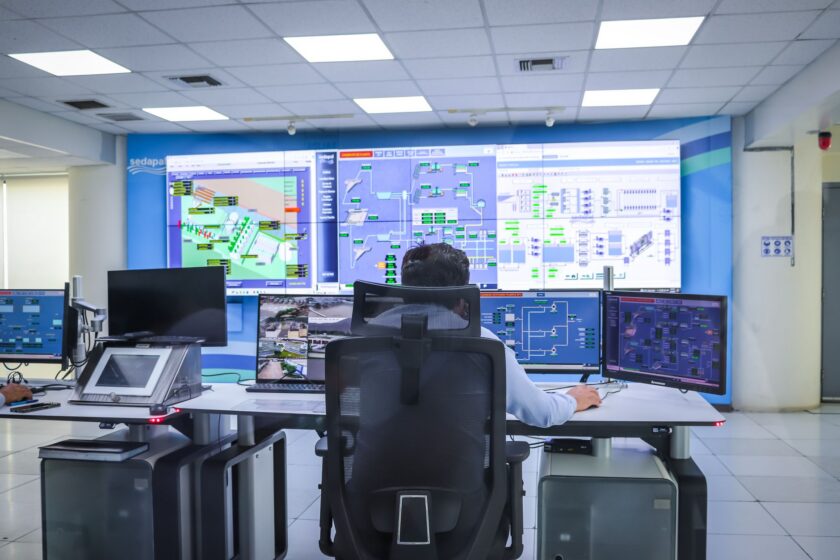

Rockwell Automation is spending 2026 doing something it has talked about since it closed the Plex Systems acquisition in 2023: actually wiring the two halves of its portfolio together. Through the current rollout cycle, Rockwell has been extending FactoryTalk Optix — its browser-based, unified HMI/SCADA design environment — with tighter native connectivity into Plex Manufacturing Cloud, the cloud-native MES it picked up in that deal. The stated goal is a more direct data path from the machine edge to cloud MES, positioned under Rockwell’s broader “Modern Application” framing for how its automation and software stacks are supposed to fit together.
For plants running Rockwell iron on the floor, this isn’t an abstract roadmap slide anymore. It’s showing up as a real fork in the road at contract renewal: take the converged Optix-to-Plex path Rockwell is building toward, or keep the independent middle layer — historian, MOM platform, custom OPC UA server, whatever you’ve got — that currently sits between your HMI/SCADA layer and MES. Both are legitimate choices. Neither is free of tradeoffs, and the sales conversation tends to undersell the second one.
What’s actually converging
FactoryTalk Optix is Rockwell’s replacement track for its older HMI/SCADA lines, built on a modern, web-native architecture rather than legacy thick-client design tools. Plex Manufacturing Cloud is a multi-tenant, cloud-native MES with roots in discrete and process manufacturing execution, quality, and shop-floor data collection. Historically these lived in separate worlds with separate data models, separate deployment philosophies (Optix largely on-prem/edge, Plex cloud-first), and no shared vendor lineage until the acquisition.
The current push is about closing that gap: tag structures and equipment context defined in Optix mapping more directly into Plex’s data model, fewer custom middleware translations, and a more prescriptive reference architecture for how machine data should flow from PLC to HMI to MES without a third party’s connector in the middle.
Why Rockwell is doing this now
The commercial logic is straightforward. A converged stack is stickier — it’s harder to swap out one piece without touching the other — and it lets Rockwell sell a more unified story against competitors who assemble best-of-breed stacks from multiple vendors. That’s not a knock on the strategy; it’s how every automation vendor with an MES arm has tried to play this game. It just means buyers should read the convergence push as a commercial strategy first and a technical inevitability second.
The licensing question you need to ask before you ask anything else
Tighter Optix-to-Plex integration raises an immediate practical question: does adopting the native path change your exposure across two license models — Optix’s typically per-device/per-project licensing and Plex’s typically per-site or per-user cloud subscription? The honest answer is that it varies by deployment scope, and you should get Rockwell or your system integrator to walk through your specific line count and site topology rather than accepting a general answer. What you can evaluate on your own is structural: does the converged path reduce the number of distinct contracts and renewal cycles you manage, or does it just add a new integration SKU on top of what you already pay for both platforms? Get that in writing before renewal, not after.
Tag and context mapping: where the real engineering work is
The unglamorous heart of this decision is data modeling. Plex, like most modern MES platforms, wants equipment, work centers, and routings modeled in a hierarchy that resembles ISA-95 — enterprise, site, area, line, work cell. Optix, at the HMI/SCADA layer, is organized around tags, alarms, and screen objects tied to controller addressing. Native convergence is supposed to reduce the manual translation between those two worlds. In practice, that means fewer hand-built OPC UA tag maps and less custom scripting to reconcile a Plex work-center ID with an Optix equipment tag — but it doesn’t eliminate the modeling work. Someone still has to define what a “line” or “asset” means consistently across both systems, and if your plant floor has grown organically over a decade of retrofits, that context doesn’t already exist cleanly in either platform. Converged tooling shrinks the integration effort; it does not remove the need for a real ISA-95-style asset model up front.
Offline and edge resilience: the part cloud demos gloss over
Plex Manufacturing Cloud is, definitionally, cloud MES. FactoryTalk Optix, run at the edge, can operate through network interruptions because it’s talking directly to controllers on the local network. The integration question that matters for plant floor reliability is what happens to production execution, work order status, and quality holds when the WAN link to Plex drops. This is not a hypothetical for anyone running in a facility with unreliable industrial network infrastructure, a remote site on cellular backhaul, or an IT security posture that segments OT traffic aggressively per IEC 62443 zone-and-conduit principles. Before committing to the converged path, get specific answers on local buffering behavior, what transactions queue versus what simply fails to record, and how reconciliation happens once connectivity is restored. A best-of-breed middle layer with its own local historian or edge buffer is, for many plants, a deliberate resilience choice — not just legacy inertia.
A framework for the renewal conversation
Plants evaluating this at renewal time should work through a short set of questions rather than defaulting to whatever the account team proposes:
- Connectivity reality: Is your plant network reliable enough, with enough bandwidth and redundancy, that cloud-first execution data doesn’t become a production risk during an outage?
- IT/OT maturity: Do you have the internal governance to manage a converged vendor stack’s patching, security zoning, and identity management, or does a more segmented architecture better match your current team’s capacity?
- Existing investment: How much custom integration, historian infrastructure, or MOM logic have you already built between HMI and MES that a converged path would strand or duplicate?
- Multi-vendor floor reality: If your plant runs non-Rockwell PLCs or HMIs anywhere on the floor, does deeper Optix-Plex convergence lock you further into a single-vendor topology you may not want?
- Exit cost: If you adopt the converged path, how hard would it be to unwind later — and is that acceptable given your plant’s typical capital planning horizon?
None of these questions have a universally right answer. A single-site plant with modern Rockwell controls, decent network infrastructure, and a lean IT/OT team has a real case for going with the converged path and letting Rockwell own more of the integration burden. A multi-plant operation with mixed automation vendors, strict OT network segmentation, and an existing MOM investment has an equally real case for keeping the independent middle layer and treating Optix and Plex as separately swappable components.
What to watch through the rest of this rollout
Keep an eye on how much of the “native integration” Rockwell ships is genuinely built-in versus how much still routes through FactoryTalk Edge Gateway or similar middleware under a friendlier label. Watch whether Plex’s ISA-95 asset modeling tools mature enough to make hierarchy setup less of a manual slog. And watch your own contract renewal terms closely — convergence pushes from any automation vendor tend to arrive with bundling incentives that are worth evaluating on their technical merits, not just their bundled price. The architecture decision here will outlast this particular renewal cycle, so it’s worth the extra week of due diligence before you sign.
This article was written with the assistance of artificial intelligence. While we aim for accuracy, the information may be incomplete, out of date, or incorrect, and should be independently verified before you rely on it for any decision. It is provided for general information only and does not constitute professional advice.