
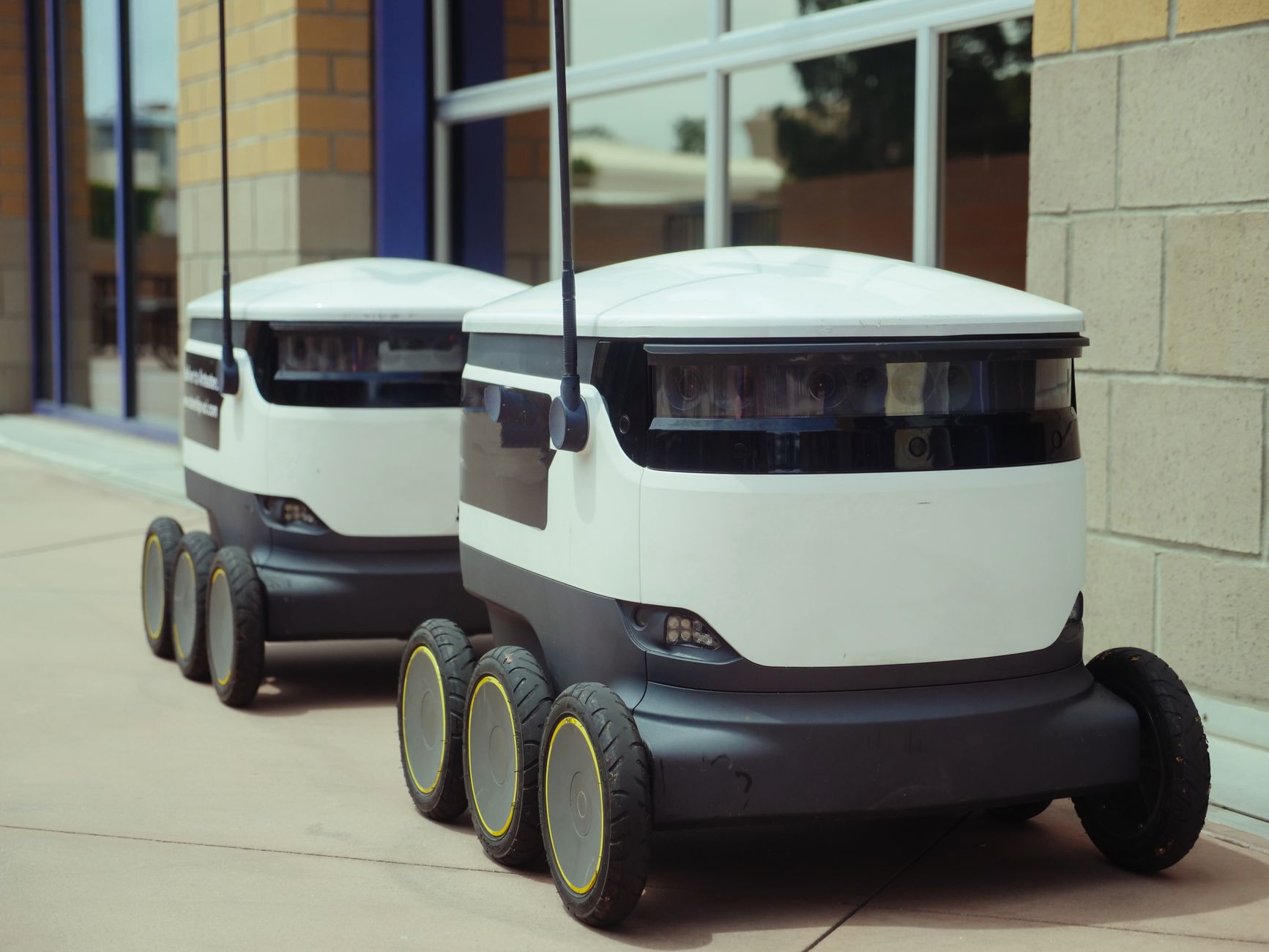
For years, buying a second AMR vendor meant buying a second fleet manager, a second set of floor markers to keep out of each other’s way, and usually a second integration contract to make the two systems politely ignore each other. VDA 5050 was supposed to fix that. As of v2.1, with several major AMR vendors shipping conformant firmware and more written into 2026 RFPs as a hard requirement rather than a nice-to-have, it’s starting to. That’s a real shift, not vendor marketing dressed up as one. But there’s a gap between “our robots speak VDA 5050” and “our plant has interoperable fleets,” and that gap is exactly where MES integration work lives.
What VDA 5050 actually standardizes
VDA 5050 is a communication interface, originally developed under the German Association of the Automotive Industry, that defines how a master control system talks to AMRs over MQTT using a common JSON message structure. It covers order messages (send a robot to a node, execute an action), state messages (position, battery, load status, errors), visualization messages, and connection/instant-action messages. Version 2.0 tightened up the action library and node/edge modeling; 2.1 refined error handling and made the spec more workable for mixed-fleet traffic scenarios.
What it does not do is act as a fleet manager, a traffic controller, or a scheduler. VDA 5050 defines the vocabulary two systems use to talk to each other — it says nothing about who decides which robot gets the intersection first, how a “pick from rack 14” work order becomes a graph of nodes and edges, or what happens when a robot’s safety-rated laser scanner disagrees with the production schedule about whether it’s safe to move. Those decisions sit above the protocol, in whatever you’re calling your master control layer, and increasingly that layer needs to talk directly to MES rather than being a black box a robotics vendor bolted on the side.
The three places “compliant” stops meaning much
Traffic management handoffs
A single-vendor fleet manager solves traffic internally — it knows its own robots’ kinematics, reservation logic, and deadlock-avoidance rules. In a mixed-vendor plant, that logic either needs to live in a vendor-neutral master control layer that all fleets report into, or you need explicit zone-based arbitration (this aisle belongs to fleet A between these hours, this intersection is mutually exclusive by traffic light logic). VDA 5050 gives you the state messages to know where every robot claims to be. It does not give you a conflict-resolution algorithm. Plenty of “VDA 5050 compliant” master control offerings pass state messages through fine and then fall back on crude zone locking the moment two vendors’ robots need to cross paths, which works until traffic density goes up and your throughput quietly craters.
Order-to-mission mapping
Your MES thinks in terms of work orders, routings, and material movements defined in ISA-95 terms. An AMR fleet thinks in terms of nodes, edges, and actions. Somebody has to translate “move lot 4471 from staging to line 3” into an actual VDA 5050 order graph, and that translation layer is where most of the real integration effort goes. It has to handle partial fulfillment, mission cancellation mid-route, re-routing when a node becomes blocked, and reporting mission completion back to MES in a form that updates inventory and triggers the next step. None of that is in the spec. It’s application logic your integrator or your MES vendor has to build, and the quality of that layer is the actual differentiator between vendors claiming VDA 5050 support.
Safety state versus schedule state
This is the one that bites people in commissioning. A robot’s local safety system — its scanner fields, its E-stop state, its degraded-speed zones — is authoritative and non-negotiable, as it should be under IEC 62443 and the relevant mobile robot safety standards. But your MES and master control layer are working off a schedule that assumes the robot will be at a certain place at a certain time. When a robot goes into protective stop because someone walked through a scanner field, VDA 5050’s state messages will tell you it happened, but your integration has to decide what to do about it: reroute other traffic, hold downstream work orders, alert an operator, or quietly wait it out. If your MES treats “robot stopped” the same as “robot completed mission, just slowly,” you’ll get phantom inventory moves and schedule drift that’s hard to trace back to its cause.
How to actually audit your MES’s AMR interface
- Ask for the VDA 5050 version and confirm it’s 2.0 or later — 1.x lacks the action library maturity you need for anything beyond basic point-to-point moves.
- Ask specifically how mixed-fleet traffic conflicts are arbitrated, not just whether state messages are exchanged. Get a real answer, not “our platform is vendor-agnostic.”
- Trace one full order lifecycle on paper: MES work order in, node/edge graph out, mission execution, exception handling, completion back to MES. If any step is “the integrator will figure that out during commissioning,” that’s unscoped work, not a finished integration.
- Test the safety-stop scenario deliberately during commissioning, not after go-live. Force a protective stop and watch what your MES does with the schedule.
- Push vendors on error code handling — VDA 5050’s error message structure is flexible enough that two “compliant” implementations can still be functionally incompatible in how they surface faults.
What to actually do about it
VDA 5050 hitting critical mass is good news for anyone tired of single-vendor lock-in on AMR fleets, and treating it as a procurement requirement in 2026 RFPs is the right instinct. But don’t let a compliance checkbox substitute for scoping the integration work that sits above the protocol. Budget real engineering time for the order-to-mission translation layer and the safety/schedule reconciliation logic specifically — those are the two places where “spec-compliant” vendors most often turn out to have shipped a thin wrapper around proprietary logic. The plants that get real value out of mixed-vendor fleets in the next couple of years won’t be the ones with the most VDA 5050 logos on a slide. They’ll be the ones whose MES integration team asked the boring questions about traffic arbitration and exception handling before signing the PO, not after the first robot parks itself in an aisle and won’t say why.
This article was written with the assistance of artificial intelligence. While we aim for accuracy, the information may be incomplete, out of date, or incorrect, and should be independently verified before you rely on it for any decision. It is provided for general information only and does not constitute professional advice.