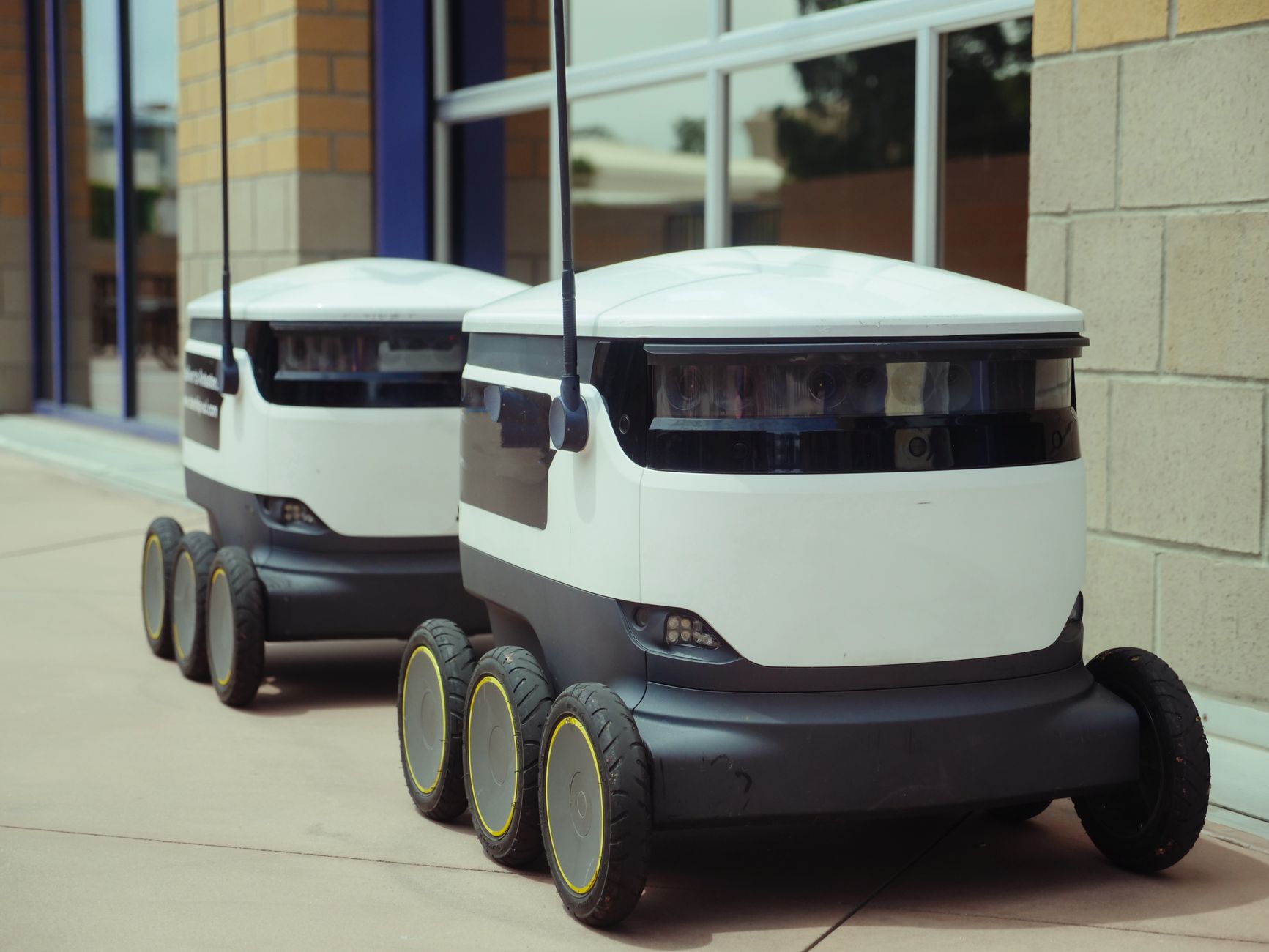
For years, integrating autonomous mobile robots from more than one vendor meant living with a pile of proprietary APIs, a fleet manager that only spoke fluently to its own hardware, and an MES team writing brittle middleware to translate between them. That’s changing, and it’s changing fast enough that if you’re writing an AMR RFP in 2026 without specifying VDA 5050 compliance, you’re already behind the rest of the buyers in the room.
VDA 5050 — the open, JSON-over-MQTT communication interface originally developed by the German Association of the Automotive Industry and VDMA — defines how a fleet master (the “master control”) talks to individual AMRs regardless of manufacturer. It standardizes order messages, state reporting, visualization data, and connection management. It does not make robots themselves interchangeable, and it does not replace your fleet manager. What it does is give you a common wire format so a master control layer can dispatch and monitor robots from different vendors without a bespoke driver for each one. That’s a real, meaningful shift, and it’s the reason multi-vendor fleets are becoming operationally viable instead of a systems-integration science project.
What’s actually mature here
The core order/state exchange is the solid part. Most established AMR vendors now ship VDA 5050-compliant interfaces (the standard has moved through several point releases, tightening semantics around order updates, actions, and error states along the way). Fleet-agnostic master control platforms — the layer that sits between your MES and the individual vendor fleet managers — have matured alongside it, and several are now doing real production work coordinating robots from multiple manufacturers on the same floor.
That’s the headline reason 2026 RFPs are different: plants that got burned integrating a single vendor’s proprietary fleet manager into their MES, then found themselves locked in when they wanted to add a second robot type for a different use case, are done doing that twice. VDA 5050 compliance is now a checkbox procurement teams use to filter vendors before technical evaluation even starts.
What VDA 5050 is not
It’s not a task allocation standard. It’s not a traffic management standard. It’s not a charging strategy. It’s not an MES integration standard, full stop — it standardizes robot-to-fleet-manager communication, not fleet-manager-to-MES communication. Every plant still has to build or buy that top layer of the stack, and every plant still owns the operational logic of who gets there first, who charges when, and what happens when a robot gets stuck in a doorway. The standard reduces integration risk at the hardware layer. It does nothing about the orchestration risk one layer up, which is where most multi-vendor deployments actually fail.
Modeling AMR tasks against your MES: get this right early
The practical question for an MES team isn’t “does our vendor support VDA 5050” — it’s “how do we represent a robot transport as a first-class object in our data model without contorting it to fit a work-order structure built for machining or assembly.” Two approaches show up in the field, and the choice matters more than it looks.
- Transport order as its own object type. Model AMR moves as a distinct entity — origin, destination, payload/carrier reference, priority, time constraints — that references but doesn’t inherit from your production work order. This lines up with how ISA-95’s material and resource models actually separate “what work is being done” from “how material gets moved,” and it keeps your work-order table from accumulating fields that only make sense for logistics.
- Transport order as a work-order subtype. Some MES platforms extend the existing work-order hierarchy to include a “move” or “logistics” order type, inheriting status codes, routing, and reporting from the same backbone as production orders. This is tempting because it reuses existing dashboards and reporting, but it tends to leak assumptions — production work orders assume a value-adding operation with cycle time and yield; transport orders assume neither, and you end up with a lot of null fields and workaround logic.
In our assessment, the cleaner long-term path is the first one: treat the transport order as a peer object linked to production orders and equipment/resource records, not a child of them. It’s more work up front and it means your reporting layer has to join across two object types instead of one, but it holds up better as robot fleets grow and as you start dispatching moves that aren’t tied to a specific production order at all — replenishment runs, kitting moves, empty-container returns.
Either way, map robot state (VDA 5050’s order states, action states, and error codes) to your existing equipment/resource status model rather than inventing a parallel one. An AMR that’s charging should show up in the same “unavailable — non-productive” bucket your MES already uses for a CNC machine in changeover, not in some robot-only status silo nobody else in the plant can query.
The gaps you will hit past a single-vendor pilot
This is where the real engineering work lives, and where plants moving from a single-vendor pilot to a multi-vendor production fleet consistently underestimate the effort.
Charging orchestration
VDA 5050 can report battery state and can carry a charging action, but deciding which robot charges when, at which station, and how that decision interacts with production priority is entirely your problem. A fleet running near capacity with poorly managed charging will produce exactly the failure mode you’d expect: robots queuing for chargers during a demand spike, which looks like a fleet-sizing problem but is actually a scheduling problem.
Traffic arbitration across vendors
Each vendor’s robots navigate their own maps with their own path planning. When robots from two vendors share aisles, intersections, and narrow passages, something has to arbitrate right-of-way across fleets — and that something is your master control layer, not the standard. This is still one of the least standardized parts of the stack, and it’s worth pressure-testing hard in any multi-vendor pilot before you scale.
Exception handling
A blocked path, a dropped payload, a robot that faults mid-order — VDA 5050 gives you error codes and state reporting, but the recovery workflow (reassign the order, alert an operator, roll back a partially completed transport in MES) is orchestration logic you have to design. Don’t assume “compliant” means “handles edge cases gracefully.” Ask vendors to demonstrate exception recovery in a live multi-robot scenario, not a spec sheet.
What to actually demand from vendors right now
Require VDA 5050 compliance stated to a specific version, not just “supported.” Ask for the master control layer’s charging and traffic-arbitration logic to be demonstrated with robots from a second vendor in the room, not just described. Push for transport-order and state data to be exposed via a documented API your MES team can consume directly, rather than routed through a proprietary dashboard export. And treat the pilot-to-scale transition as its own project phase with its own budget and timeline — the standard has closed the integration gap at the robot layer, but the orchestration and data-modeling work above it is still yours to do, and it’s the part that actually determines whether the fleet works.
This article was written with the assistance of artificial intelligence. While we aim for accuracy, the information may be incomplete, out of date, or incorrect, and should be independently verified before you rely on it for any decision. It is provided for general information only and does not constitute professional advice.