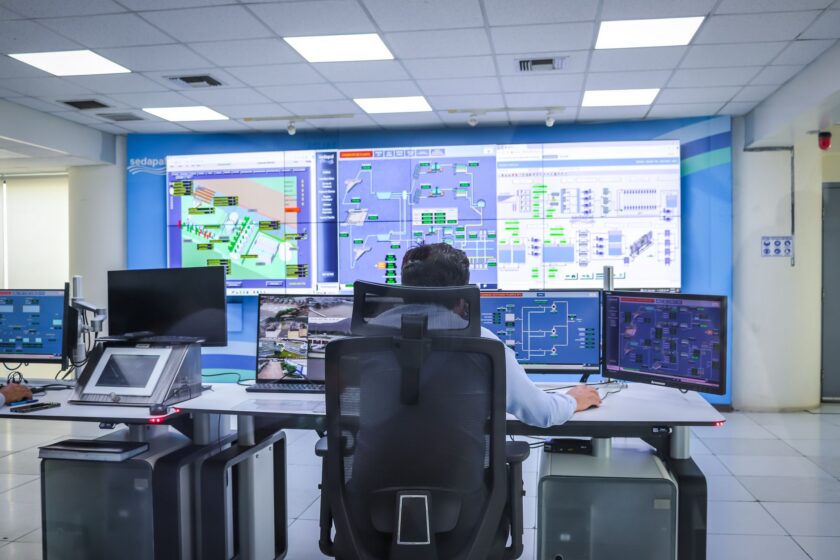

Nobody decides to build a shadow-MES. It accumulates. Someone stands up a digital twin for changeover simulation, it works well, so a scheduler starts trusting its what-if output over the actual scheduling module. Someone else wires the twin to live line data for “visualization,” and six months later a supervisor is making changeover-sequence calls based on twin output that never touched the quality system. Nobody re-scoped anything. The system of record just moved, quietly, without anyone signing off on it.
This is the real story behind the current wave of digital twin platform updates. NVIDIA Omniverse, Siemens Xcelerator, and AVEVA’s twin offerings have all pushed hard toward higher-fidelity, more real-time, more bidirectional plant models — twins that don’t just render what happened but simulate what should happen next and, increasingly, feed that recommendation straight back into operations. That’s genuinely useful technology. It’s also exactly the kind of capability creep that erodes system-of-record boundaries if plant IT doesn’t draw a line and defend it.
What actually changed
For most of digital twin history, the boundary was easy to respect because the twin couldn’t do much that mattered. It was a 3D visualization layer, a training environment, or an offline simulation sandbox fed by historized data. Nobody confused that with execution authority because the twin had no path back to the floor and no real-time truth to argue with.
That’s not the pitch anymore. Modern twin platforms increasingly support bidirectional sync with OPC UA and MQTT Sparkplug B data streams, near-real-time state reconciliation, and optimization engines that generate scheduling and sequencing recommendations directly from live conditions. Some vendors are explicitly marketing predictive scheduling and quality-prediction features as twin capabilities, not as adjuncts to the MES or APS layer. The technical barrier that used to keep twins in a supporting role — latency, data freshness, model fidelity — is eroding. What’s not eroding at the same pace is governance: who owns dispatch decisions, who owns genealogy, who’s accountable when a twin-generated recommendation turns out wrong on a regulated product.
The line that matters: authority, not accuracy
The mistake practitioners make is asking “is the twin accurate enough?” That’s the wrong test. A twin can be extremely accurate and still be the wrong system to hold execution authority, because accuracy isn’t what MES-of-record status is actually about. It’s about auditability, genealogy linkage, validated change control, and a defensible chain of custody for every decision that touches a physical unit of product.
Here’s a way to sort functions that holds up under scrutiny:
Safe for the twin to own
- Simulation and what-if scenario testing — running hypothetical schedules, changeover sequences, or line configurations before committing anything to the floor.
- Optimization exploration — generating candidate schedules or parameter sets for a human scheduler or the APS/MES to evaluate and formally accept.
- Operator and engineer training — practicing changeovers, fault response, or new product introductions in a synthetic environment with no physical consequence.
- Predictive insight generation — flagging that a quality excursion is likely under current conditions, as an advisory signal, not a disposition.
Must stay in MES-of-record
- Dispatch — the actual instruction to run a specific work order, on a specific line, in a specific sequence, right now.
- Genealogy and traceability — the recorded linkage between raw material lots, process parameters, and finished units. This has to be an auditable, validated data path, not a simulation artifact.
- Quality disposition — accept, reject, rework, hold. This is a regulated decision in most industries and needs a system with electronic signature support, audit trail, and validated logic, per the expectations baked into frameworks like ISA-95 and, in regulated sectors, GxP/21 CFR Part 11 practices.
- Any action with a permanent, physical, or safety consequence — if it can’t be undone by re-running the simulation, it doesn’t belong to the twin.
The pattern underneath both lists is simple: the twin can propose, explore, and predict. Only the MES — or a human backed by the MES — should commit and record. The moment a twin’s output drives an action on the floor without passing through that system of record, you’ve created an unvalidated execution path, whether or not anyone calls it that.
Auditing what you’ve already got
Most plants running an advanced twin deployment have already crossed this line somewhere, usually in a spot nobody thinks to check because it doesn’t look like an MES decision — it looks like “the twin suggested it and the operator went with it.” A practical audit checklist:
- Trace every bidirectional data link. Anywhere the twin writes back to a PLC, SCADA tag, or MES interface — not just reads from one — is a candidate for scrutiny. Map what triggers those writes and who approved the logic.
- Find the “advisory becomes instruction” points. Interview schedulers and supervisors directly: where do you use twin output as the actual plan rather than a suggestion you cross-check? This is almost always informal and undocumented, which is exactly the risk.
- Check genealogy continuity. If a changeover or parameter set was driven by twin simulation, is that traceable in the batch or work-order record, or does the genealogy just show the outcome with no link to the decision that produced it?
- Look for orphaned quality logic. Any quality-prediction model running in the twin that influences accept/reject behavior without a matching, validated path through the quality module is a compliance exposure waiting to surface in an audit.
- Confirm change control covers the twin. If the twin’s optimization model or fidelity gets updated by the vendor or an internal team, does that go through the same change-control process as an MES configuration change? If not, you have an unmanaged variable sitting upstream of production decisions.
What to actually do about it
None of this means slowing down twin adoption — the simulation and optimization gains are real, and platforms like Omniverse, Xcelerator, and AVEVA’s twin products are legitimately useful for what they’re built for. The fix is governance, not retreat. Write down, explicitly, which decisions the twin is allowed to make unilaterally and which require a round-trip through MES with a logged, attributable transaction. Put that boundary in the twin’s implementation documentation, not just in a Slack thread from the original project. And when a vendor demo shows the twin closing the loop automatically — scheduling, sequencing, dispositioning — ask the uncomfortable question out loud: is that recommendation, or is that execution? If your team can’t answer cleanly, that’s the gap you need to close before the twin closes it for you.
This article was written with the assistance of artificial intelligence. While we aim for accuracy, the information may be incomplete, out of date, or incorrect, and should be independently verified before you rely on it for any decision. It is provided for general information only and does not constitute professional advice.